
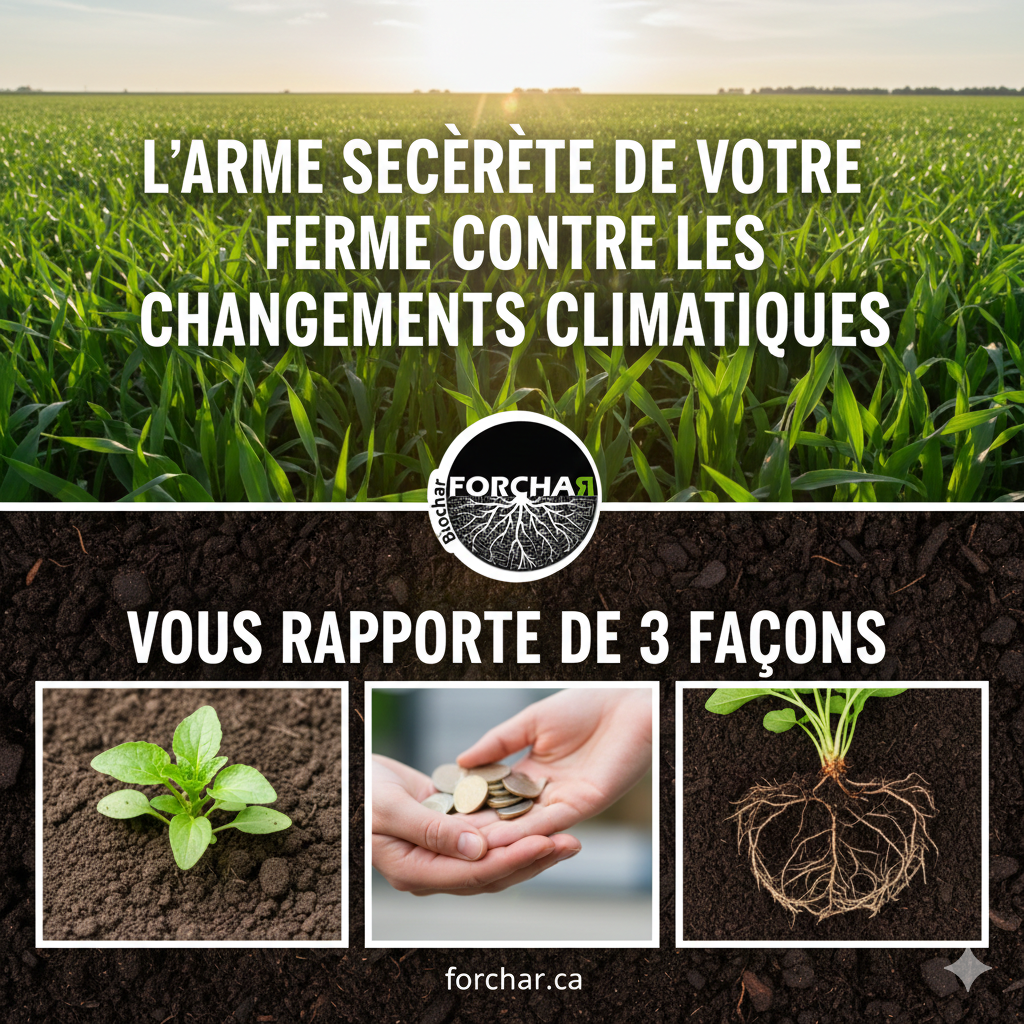
L’arme secrète de votre ferme contre les changements climatiques vous rapporte de 3 façons
What if I told you there was just one amendment that could increase your yields by 38%, reduce your water bills AND make you pay to fight climate change?
Sounds too good to be true? Farmers across Quebec and around the world are already achieving exactly these results with biochar—and the science behind it is stunning.
The numbers don’t lie: the triple performance of biochar
Let's get straight to the point: your profitability and the future of your floors.
Yield increases that defy logic
Recent global meta-analyses tracking thousands of farms reveal that the impact of biochar on crop productivity is nothing short of remarkable. Here's what the data shows:
| Crop type | Average yield increase | Optimal conditions |
|---|---|---|
| Oilseed plants (Canola, Soya) | 37 % | Acidic soils (pH 5-6) |
| Vegetables | 28 % | Sandy or clayey soils |
| Legumes | 26 % | Low nitrogen supplies |
| Corn | 16-20 % | Tropical climates |
| Wheat | 12-16 % | Long-term applications |
| Rice | 6 % | Flooded Conditions |
But here's where it gets interesting: These aren't one-year wonders. A four-year study in Colombia showed corn yields increasing by 20%, 30% and 140% in years 2, 3 and 4 respectively, proving that the benefits of biochar accumulate over time.
Carbon calculations that could save you money
As you grow better crops, your soil is literally removing carbon from the atmosphere. Let's break down the potential:
Global carbon sequestration potential:
| Source | Annual CO₂ removal potential | Scale |
|---|---|---|
| Global crop residues | 3.7 billion tonnes of CO₂ per year | Global technical maximum |
| Sustainable harvest scenario | 360 million tonnes/year after a century | Conservative estimate |
| Cultivated land of China only | 27.1 to 45.8 billion tonnes of CO₂ | National impact |
| Quebec farm (average) | 50-100+ tonnes of CO₂/year | Per 100 hectares |
What this means for you: With the emergence of carbon markets, it's not just an environmental impact—it's a potential new revenue source. Biochar is already valued in carbon markets, and early adopters are positioning themselves to benefit.
Transformed soil properties
The real magic happens underground. Studies show that biochar increases soil porosity by 23%, weight average diameter by 46%, and decreases bulk density by 19% in acidic tropical soils. In practical terms:
| Land ownership | Improvement | What it means to you |
|---|---|---|
| Water retention | +47% in certain soils | Survive droughts, irrigate less |
| Nutrient retention capacity | +36% soil organic carbon | Fertilizer stays where you put it |
| pH buffering | +0.5 to 2.0 units | Reduces lime requirements |
| Microbial activity | +100-300 % | Natural disease suppression |
| Soil structure | +46% aggregate stability | Less erosion, better root growth |
But here's the rub (and why most farmers get it wrong)
Not all biochars are created equal. The research is clear: production temperature, raw material and application method make or break your results .
The optimal temperature point
Higher pyrolysis temperatures create biochar with greater carbon stability and increased sequestration potential. Biochar produced at higher temperatures contains more recalcitrant carbon and develops a more condensed and stable structure. For maximum carbon sequestration, aim for biochar produced at 500-600°C.
Matter matters
Biochar made from manure outperformed wood-based biochar with a 42% yield increase compared to 22% for woody materials and 12% for grain residue. But wood-based biochar excels at storing carbon and improving soil structure.
At FORCHAR, our wood-based biochar of Quebec origin is optimized for:
- Maximum carbon stability (hundreds to thousands of years)
- Porous structure ideal for water and nutrient retention
- Compatibility with soil types and climate in Quebec
The economic reality check
Let's talk about money and common sense. Many farmers are hesitant because of the upfront costs, but the numbers tell a different story:
Break-even analysis (100 hectares):
| Year | Investment | Benefits | Net position |
|---|---|---|---|
| Year 1 | 15 000 $ | Increased yield + water savings: $8,000 | -7 000 $ |
| Year 2 | 0 $ | Cumulative profits: $12,000 | +5 000 $ |
| Year 3 | 0 $ | Maximum profits + carbon credits: $18,000 | +23 000 $ |
| Year 4+ | 0 $ | Benefits supported: $15,000/year | Cumulative gain |
Note: These are conservative estimates based on average corn/wheat operations. Results vary depending on soil type, climate and management practices.
Real-world application strategy
Success with biochar isn't about dumping it on your fields and hoping for the best. Here is the proven approach:
Phase 1: Test and learn (Year 1)
- Start with 2 to 5 hectares of test plots
- Apply 10 to 20 tonnes per hectare (optimal rate for most soils)
- Monitor soil moisture, crop performance and nutrient needs
- Document everything
Phase 2: Refine and expand (Year 2)
- Adjust application rates based on year 1 results
- Expand to 25-50% of target area
- Combine with reduced fertilizer inputs (20-30% reduction possible)
- Start documenting carbon credits
Phase 3: Full Implementation (Year 3+)
- Expand to remaining area with proven settings
- Implement precision application techniques
- Access carbon markets for additional income
- Refine for maximum ROI
The climate crisis timeline you need to know
Here's what should keep you up at night: atmospheric CO₂ concentration reached 422 ppm in 2024 and could reach 600-700 ppm by the end of the century without intervention. For agriculture, this means:
- More extreme weather events
- Changing growing seasons
- Increased pest pressure
- Acceleration of land degradation
Biochar is not just an opportunity—it is becoming a necessity.
Why Quebec farmers have the advantage
Our climate, soil types and agricultural systems are particularly well positioned to benefit from biochar:
- Acidic soils dominate - exactly where biochar performs best
- Cold winters - the thermal properties of biochar protect soil biology
- Short growing seasons - every percentage point of yield counts
- Solid agricultural heritage - knowledge to implement innovative practices
- Local production available - FORCHAR eliminates transportation emissions
Questions You Should Ask (And We'll Answer Honestly)
“Will this work on my floor?” » Most likely, yes. Biochar performs best in acidic to neutral soils (pH 4.5-7), sandy or clay textures, and where organic matter is less than 3%. This describes more than 70% of Quebec's agricultural land.
“What about my specific culture? » The data shows profits in virtually all crops, with the biggest gains in vegetables, oilseeds and corn. Even crops with modest average gains (like rice) see dramatic improvements under specific conditions.
“How long until you see results? » You will notice changes in soil texture immediately. Measurable increases in yield typically appear as early as year 2, with benefits accumulating through year 4 and beyond.
“What if I'm already using organic amendments? » Perfect. Biochar + compost or manure creates synergistic effects. Studies show that a single application of biochar combined with compost improved yields over three consecutive growing seasons.
The bottom line
In 20 years, every successful farm will be using biochar. The question is: will you be an early adopter capturing all the benefits, or will you be playing catch-up?
The data is clear:
- Proven yield increases of 16-38% on average
- Massive carbon sequestration potential
- Cumulative benefits that improve over time
- Reduced input costs for water and fertilizer
- Emerging revenues from carbon markets
The risk is minimal:
- Biochar cannot “burn” plants like synthetic fertilizers
- It does not wash off or wash off
- Benefits persist for centuries
- Start small and increase gradually
- Return on investment generally achieved from year 3
Ready to stop leaving money (and carbon) on the table?
Farmers who see 30%+ yield increases didn't wait for perfect conditions—they started with a test plot and let the results speak for themselves.
The biochar produced in Quebec by FORCHAR is designed for our climate, our soils and our crops. We work directly with farms to:
- Analyze your soil and recommend optimal application rates
- Providing biochar produced from local and sustainable sources
- Support you in implementation and monitoring
- Connect to emerging carbon credit opportunities
- Share data from farms like yours
Contact our team today for a free assessment of your farm:
- Telephone: +1 (437) 343-7339
- Email: info@forchar.ca
- Website: forchar.ca
The science is established. The economics are compelling. The time to act is now.
Sources: Data compiled from peer-reviewed meta-analyses published in Nature Communications, Scientific Reports, GCB Bioenergy and leading agricultural journals (2020-2025). All statistics represent averages from multiple field trials. Individual results vary depending on soil conditions, climate, management practices and biochar characteristics.