
Le Saviez-Vous? Le Biochar Transforme Tranquillement les Champs de Maïs au Québec
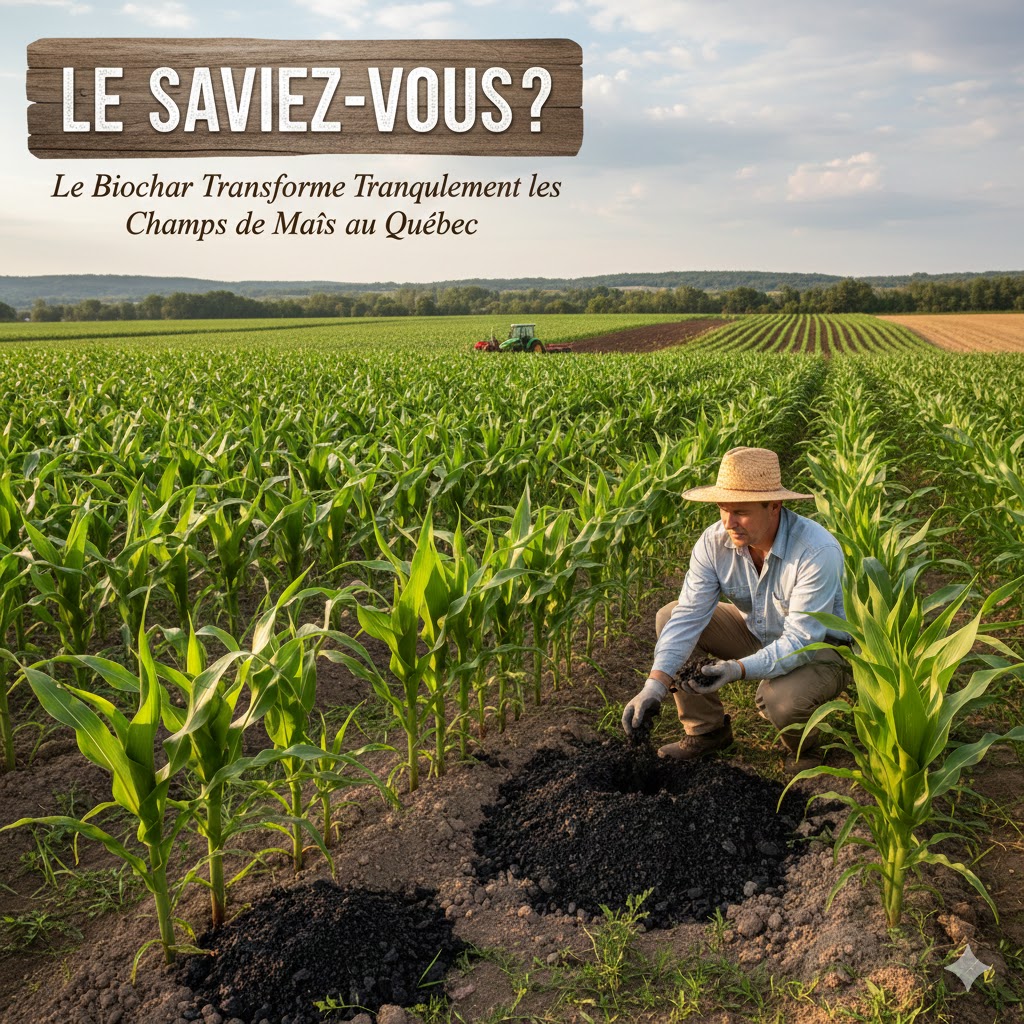
Did you know that applying biochar in October and November gives Quebec soils a head start before winter?
When most producers in Quebec finish harvesting, repair machinery or apply the last amendments before winter, a practice is slowly gaining popularity among innovative producers: the application of biochar in the fall — just before the first snow.
While many amendments lose effectiveness once the cold sets in, biochar does exactly the opposite. Fall is actually one of the best times of year to apply it. Here's why.
1. Freeze–thaw cycles do the work for you
Once the biochar is applied in October or November, Quebec's natural winter conditions take over.
During the season, the soils:
- freeze and contract,
- thaw and expand,
- create microcracks,
- open natural pathways in the soil profile.
This cycle mechanically integrates the biochar deeper into the root zone — without any additional work.
❄️ Winter literally improves your incorporation.
In spring, the biochar is no longer on the surface: it is positioned where the corn roots will really benefit from it.
4. Protects nutrients throughout the cold season
When biochar is applied before snowfall, it begins to act as a nutrient sponge during spring melt and runoff.
It helps to:
- capture nitrogen,
- reduce phosphorus losses,
- stabilize potassium,
- retain micronutrients like boron, zinc and manganese.
Instead of nutrients leaving with meltwater, biochar retains them until the roots need them.
🌧️ Less losses. More availability. Better efficiency.
5. Improves humidity stability in spring
One of the biggest challenges in Quebec is the rapid transition between:
- soils that are too wet in April/May,
- and the sudden drying towards the end of May/beginning of June.
Biochar applied in the fall helps buffer this transition by:
- improving drainage during melting,
- increasing the retention capacity once the soil dries,
- supporting root development during the critical period V2–V6.
🌱 Better resilience at the start of the season = better final yield.
6. Turn winter into “soil improvement season”
Normally, nothing improves during the winter.
With biochar, it’s the opposite: winter becomes a period of positive soil development where:
- microorganisms colonize the pores of the biochar,
- organic residues naturally bind to biochar surfaces,
- soil aggregates strengthen.
When the machinery enters the field in the spring, the soil has already benefited from several months of improvement — without fuel, without labor, without effort.
7. Reduces the risk of compaction and damage to fields
Autumn soils are often:
- drier,
- more supportive,
- less prone to rutting than the humid soils of Quebec spring.
Applying biochar in October–November allows you to:
- avoid the entry of heavy equipment into fragile soils in spring,
- reduce structural damage,
- preserve soil health.
🚜 A well-protected structure in the fall = better soil-grain contact in the spring.
Conclusion: Quebec winters are long — make them work for you
Applying biochar before the snow arrives isn't just a good idea — it's a strategy.
Instead of waiting until spring to “repair” soil, fall application allows producers to:
- get ahead of the season,
- improve the soil naturally during the winter,
- retain nutrients,
- and start spring with a healthier, more responsive seedbed.
In a province where the season is short and every day counts, biochar applied in the fall is one of the few practices that offers you a free value thanks to winter itself .
Did you know that the use of biochar in corn fields in Quebec can directly influence the volume of harvests, the vigor of the plants and the speed of growth , particularly in our climatic conditions where every day of growth counts?
In Quebec, producers must deal with very specific realities: cool springs which delay establishment, soils compacted by freezing and thawing, and occasional water stresses which often occur between emergence and bolting. It is precisely in these situations that biochar can make a noticeable difference.
How biochar concretely improves the performance of corn in Quebec
1. Faster initial growth
In several tests carried out in northern climates, biochar has shown an ability to warm and lightly aerate the seedbed , allowing for more uniform lifting. An advance of 2 to 4 days at the start of the season may be sufficient to maximize yield potential, especially for high heat unit hybrids.
2. A denser and deeper root system
The pores in the biochar create a more stable environment for the roots. Result:
- more root volume ,
- better ability to fetch water ,
- increased tolerance to dry stress ,
- and resilience in compacted soil conditions .
For corn, this often results in more even growth and more uniform plants in the field.
3. Better response to applied fertilizers
Several Quebec producers note that corn treated with biochar responds better to nitrogen inputs during the season (lateral N) . The biochar acts as a buffer zone, which improves the progressive availability of nitrogen during key stages (V6 to ear formation).
This can lead to:
- more robust stems ,
- better filled ears ,
- and sometimes a slight reduction in nitrogen losses without reducing performance.
4. Possible improvement in grain quality
Under conditions of water or thermal stress, biochar has demonstrated the ability to stabilize:
- the specific weight ,
- the average grain size ,
- and the starch rate .
Hybrids sensitive to climatic fluctuations particularly seem to benefit from this stability.
5. Regularity of returns from one year to the next
One of the points most appreciated by Quebec agronomists and producers:
biochar not only contributes to better results in good years, but especially reduces the loss of yield during bad years (spring too cold, periods of drought, excess water early).
This factor is often more important than the gross increase in yield.
In summary – Biochar in Quebec corn fields is mainly:
- a more uniform rise,
- more powerful roots,
- a better response to fertilizers,
- greater stability in the face of climate,
- a more consistent yield, even in difficult years.